
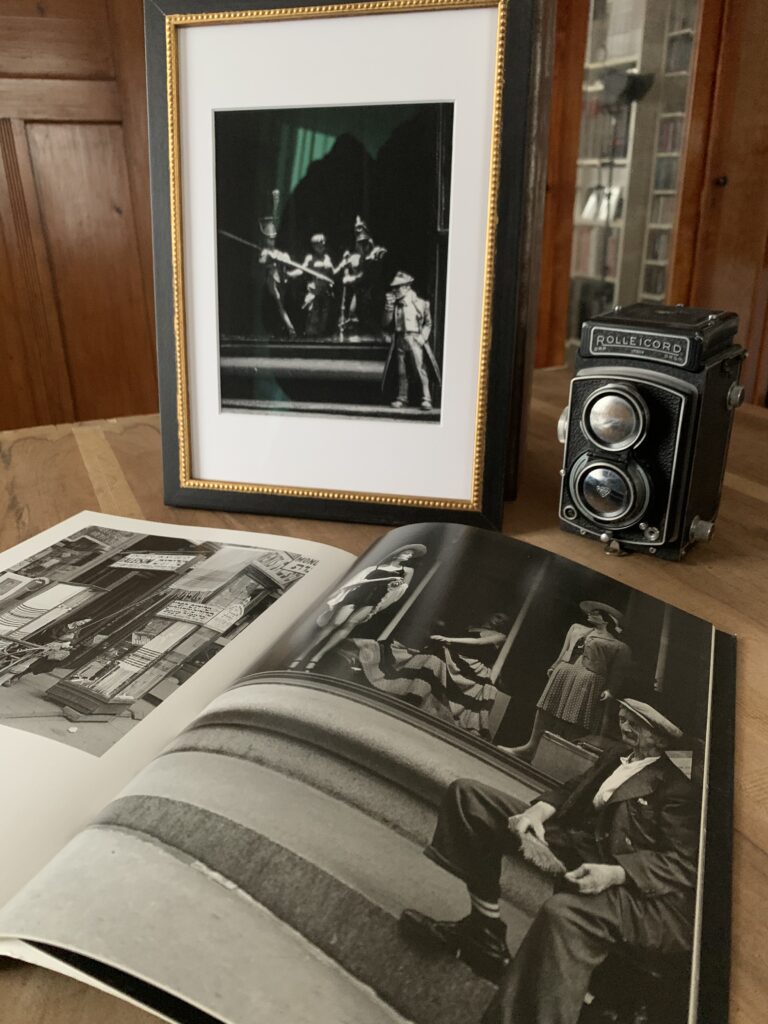
A major inspiration for me, both stylistically and conceptually, is Andreas Feininger. In his book New York in the Forties, there is a photograph of a shoe cleaner standing in front of a shop window that has stayed with me for years. The image is not remarkable because of technical perfection. What makes it unforgettable is its atmosphere — a quiet psychological tension that lingers long after looking at it.
Feininger once wrote:
“The fact that a photograph which is technically flawed (in the conventional sense) can be more emotionally powerful than a technically flawless image will come as a shock to those naive enough to believe that technical perfection constitutes the true value of a photograph.”
This idea feels especially relevant to miniature photography. A world built in 28mm scale is inherently artificial: an imperfect reconstruction of reality assembled from XPS foam, glue, resin, plastic, paint, and illusion. It can never fully convince as reality — and yet that very imperfection is what interests me. Miniatures occupy an uneasy space between representation and abstraction. They ask the viewer to participate in the illusion rather than simply consume it.
For me, the emotional truth of an image matters far more than technical credibility.
Constructing the Scene
What fascinated me about Feininger’s original photograph was the tension between the shoe cleaner and the elegant shop window behind him — a contrast between poverty and glamour, exclusion and aspiration.
In my own interpretation, I was less interested in reproducing that social commentary directly. Instead, I wanted to transform the image into something more psychological. The central tension became the act of observation itself.
While searching through my collection of miniatures, I found the key elements almost immediately — a pulp-style detective and a series of “historic” pin-up miniatures that could function as mannequins inside the shop window.
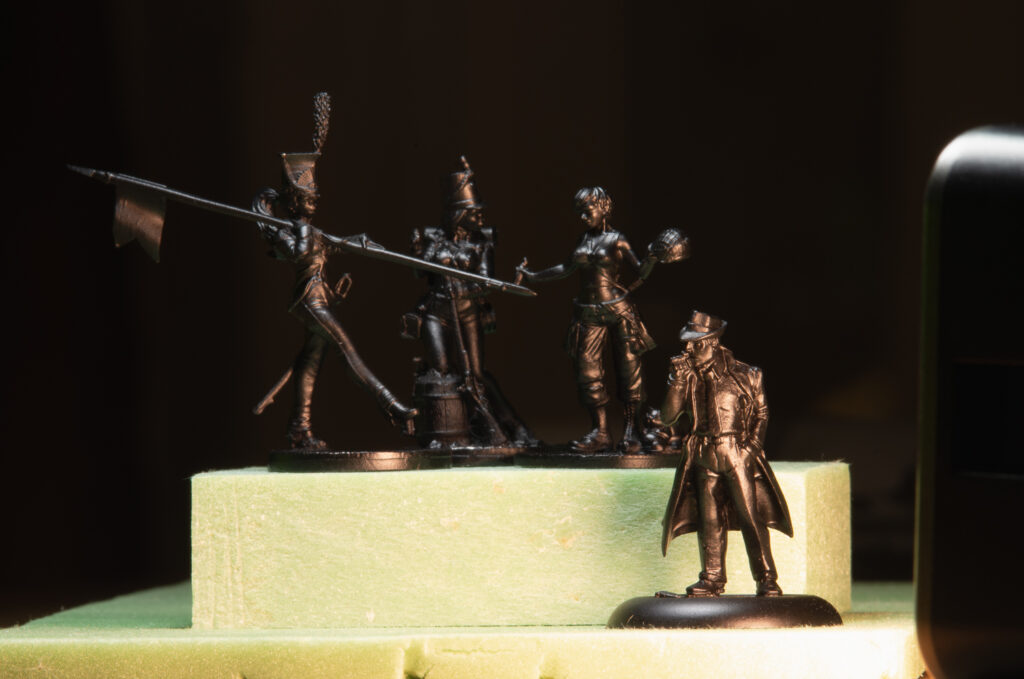
At first glance, the detective appears to control the scene. He is the observer, the investigator, the one searching for meaning. But the mannequins quietly reverse the gaze. Their presence destabilises the image and introduces an uncomfortable ambiguity: the observer becomes the observed.
Building the Environment
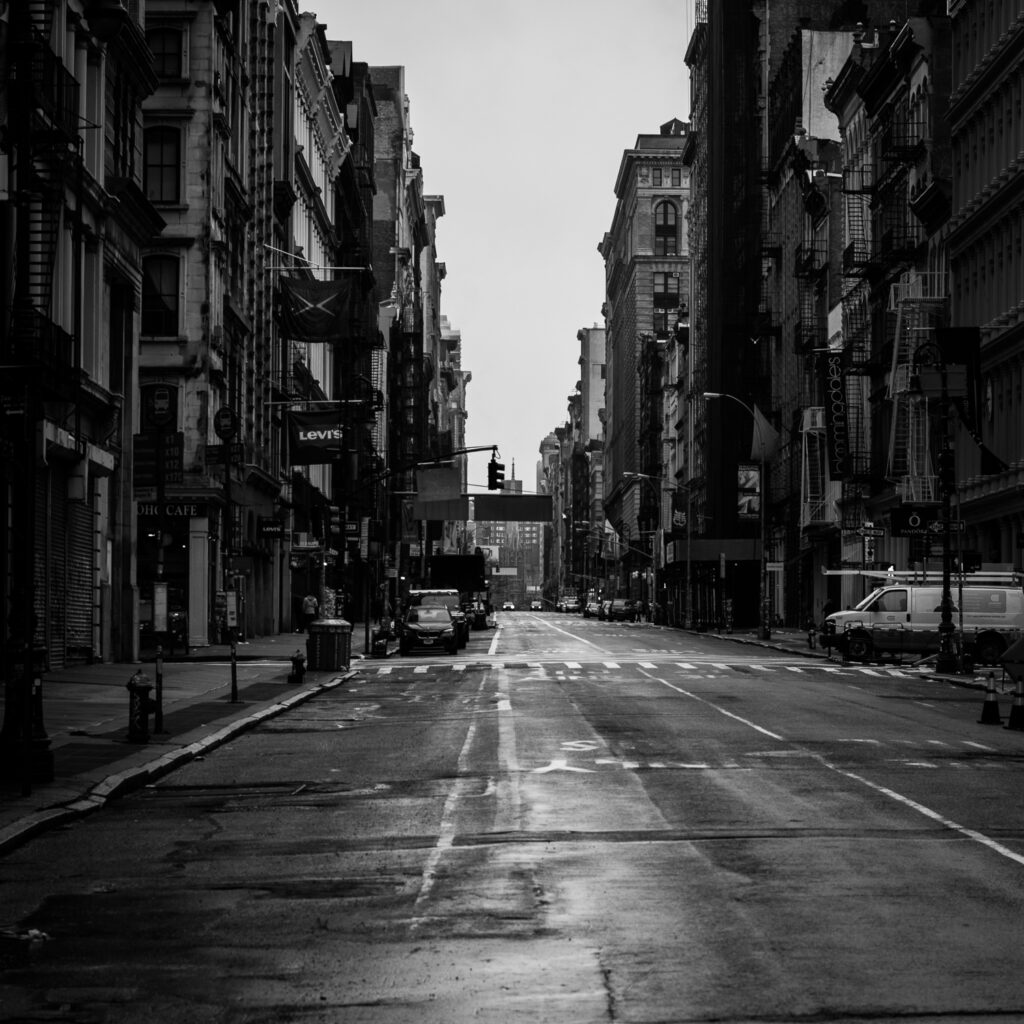
The storefront was designed as part of a larger urban environment rather than as an isolated stage set. Anyone familiar with New York City understands that these storefronts are fragments of something larger: apartment buildings, offices, anonymous lives stacked above the street.
I wanted the miniature architecture to preserve that feeling of density and continuity while still integrating with my existing Hive City terrain system. The building therefore became less a replica of a specific location and more an interpretation of urban memory — a compressed version of the visual language associated with mid-century Manhattan streets.
Working in miniature always involves a balance between realism and suggestion. Complete realism is impossible at this scale. Instead, surfaces, proportions, lighting, and texture become tools for constructing atmosphere. The goal is not deception, but emotional plausibility.


The Final Image
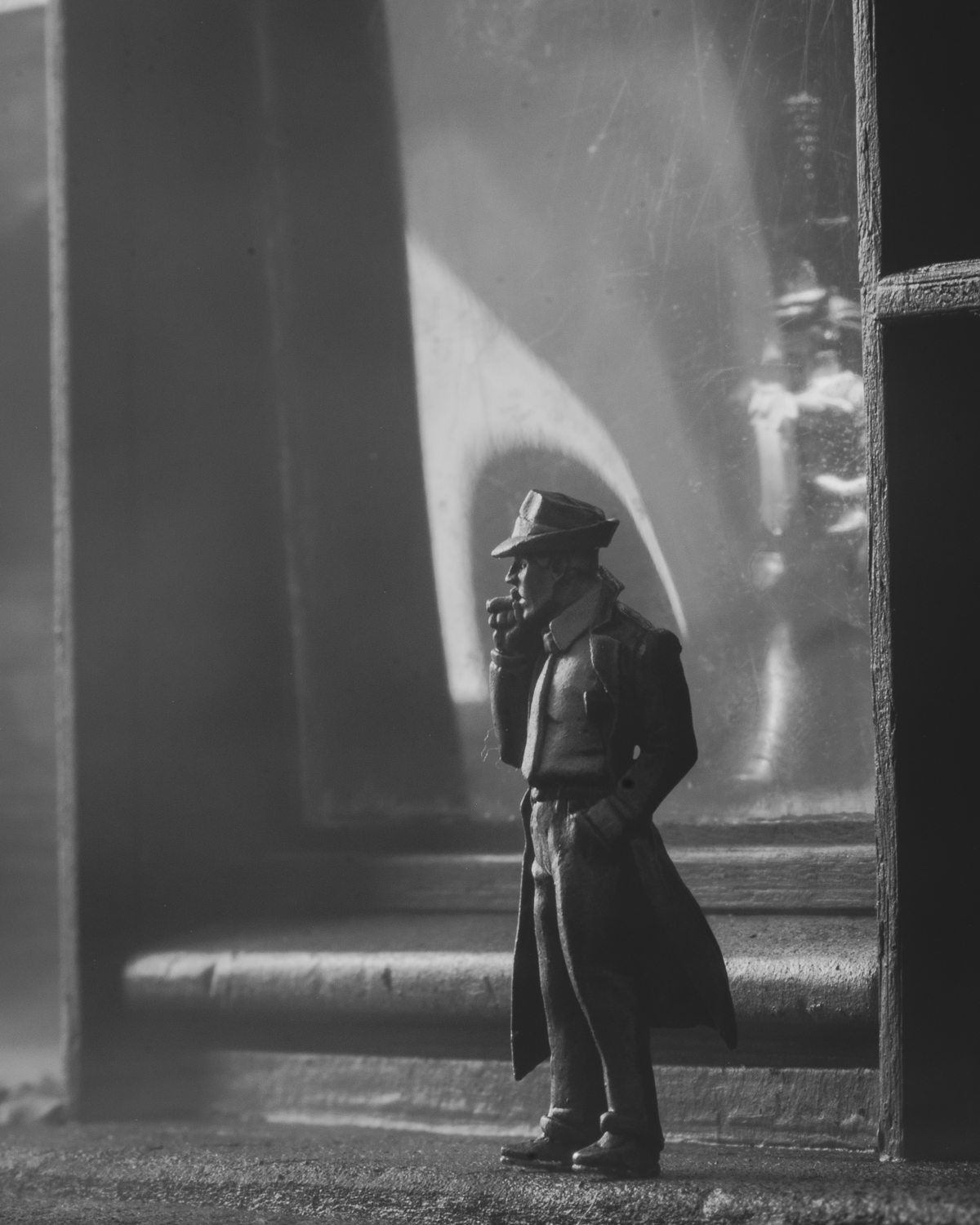
The final photograph, Are They Watching Me?, is ultimately an attempt to explore how unease can emerge from stillness.
What interests me is not whether the scene appears perfectly real, but whether it feels psychologically convincing. The miniature world remains visibly artificial, yet perhaps that artificiality allows the image to operate more like memory or cinema than straightforward documentation.
In that sense, Feininger’s observation becomes even more meaningful: technical imperfection is not necessarily a limitation. Sometimes it is precisely what allows an image to become emotionally alive.
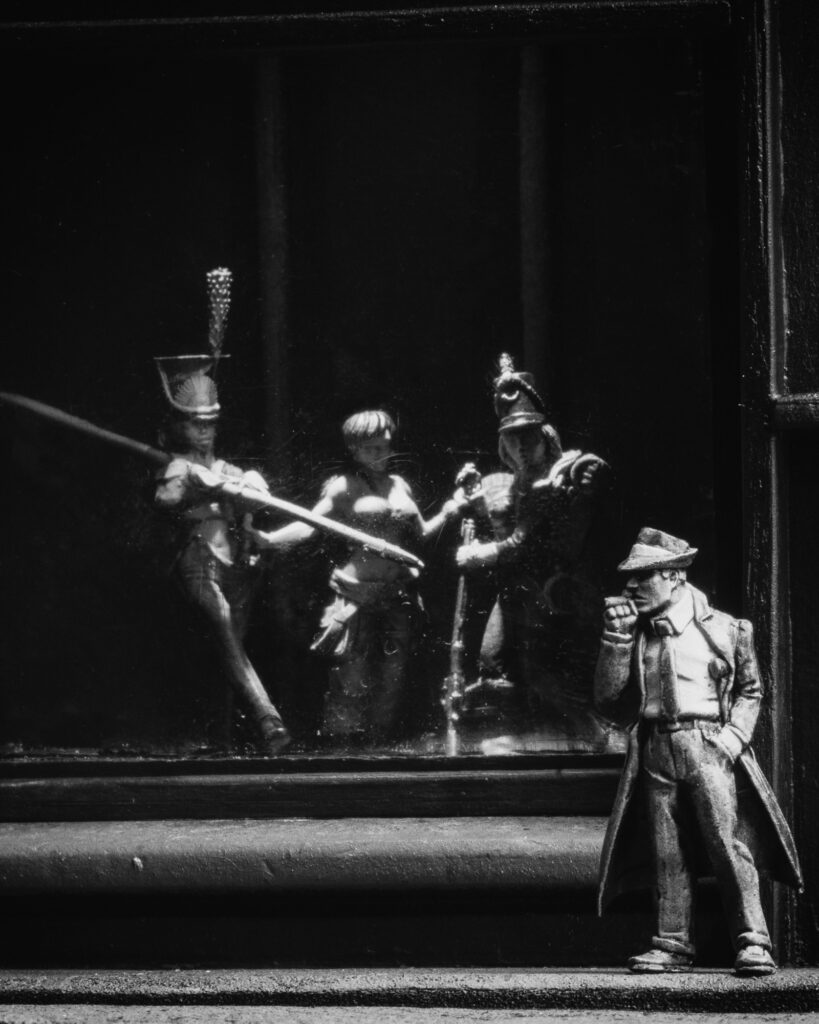
Rather than translating Feininger’s social tension directly, I became interested in how miniature photography could transform it into psychological unease — a shift from class and visibility toward surveillance, perception, and self-awareness.
Technical Details
- Camera: Pentax K-5
- Lens: HD PENTAX-D FA Macro 100mm F2.8ED AW
- Settings: f/22 · ISO 400 · 3.0 s exposure
- Post-processing was done using Adobe Lightroom, Adobe Photoshop, and Nik Silver Efex.
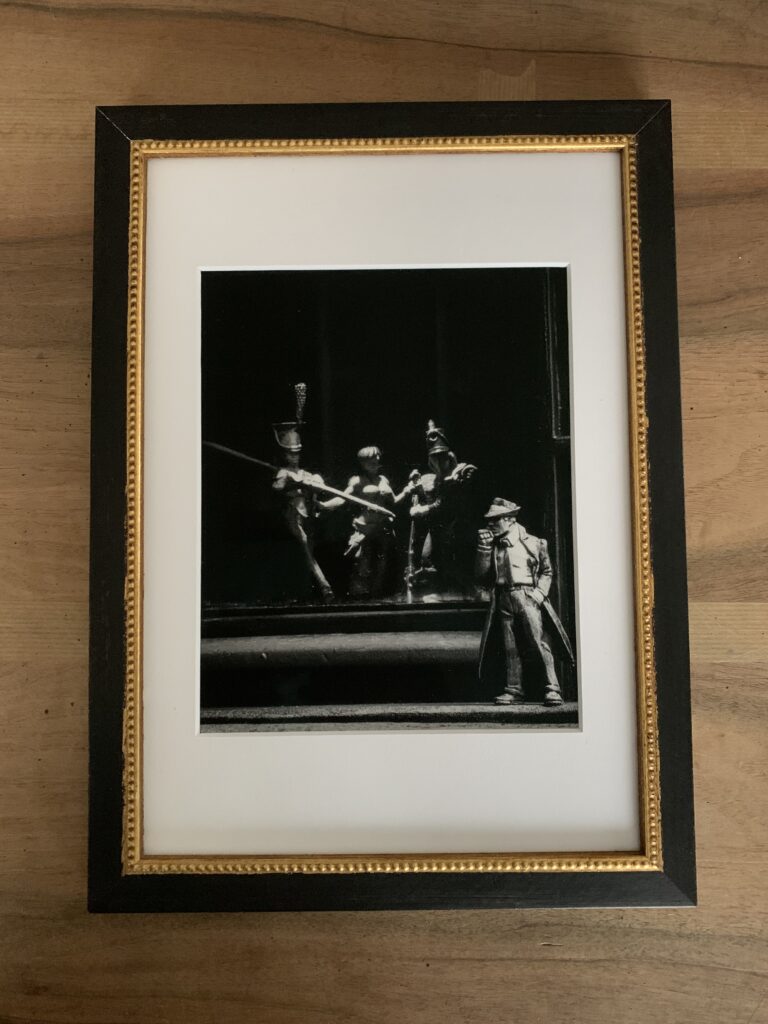
- 19 × 16 cm
- Printed on Hahnemühle Museum Etching paper, 350 g/m²
- Wooden frame with museum glass and passe-partout
Comments
One response to “Inspired by Andreas Feininger”
Mentions