Tag: Miniature Photography

  • Inspired by Andreas Feininger

    Inspired by Andreas Feininger

    A major inspiration for me, both stylistically and conceptually, is Andreas Feininger. In his book New York in the Forties, there is a photograph of a shoe cleaner standing in front of a shop window that has stayed with me for years. The image is not remarkable because of technical perfection. What makes it unforgettable is its atmosphere — a quiet psychological tension that lingers long after looking at it.

    Feininger once wrote:

    “The fact that a photograph which is technically flawed (in the conventional sense) can be more emotionally powerful than a technically flawless image will come as a shock to those naive enough to believe that technical perfection constitutes the true value of a photograph.”

    This idea feels especially relevant to miniature photography. A world built in 28mm scale is inherently artificial: an imperfect reconstruction of reality assembled from XPS foam, glue, resin, plastic, paint, and illusion. It can never fully convince as reality — and yet that very imperfection is what interests me. Miniatures occupy an uneasy space between representation and abstraction. They ask the viewer to participate in the illusion rather than simply consume it.
    For me, the emotional truth of an image matters far more than technical credibility.

    Inspired by Andreas Feininger
    Inspired by Andreas Feininger

    Constructing the Scene

    What fascinated me about Feininger’s original photograph was the tension between the shoe cleaner and the elegant shop window behind him — a contrast between poverty and glamour, exclusion and aspiration.
    In my own interpretation, I was less interested in reproducing that social commentary directly. Instead, I wanted to transform the image into something more psychological. The central tension became the act of observation itself.
    While searching through my collection of miniatures, I found the key elements almost immediately — a pulp-style detective and a series of “historic” pin-up miniatures that could function as mannequins inside the shop window.

    Miniatures for the Photograph
    Miniatures for the Photograph

    At first glance, the detective appears to control the scene. He is the observer, the investigator, the one searching for meaning. But the mannequins quietly reverse the gaze. Their presence destabilises the image and introduces an uncomfortable ambiguity: the observer becomes the observed.

    Building the Environment

    The storefront was designed as part of a larger urban environment rather than as an isolated stage set. Anyone familiar with New York City understands that these storefronts are fragments of something larger: apartment buildings, offices, anonymous lives stacked above the street.
    I wanted the miniature architecture to preserve that feeling of density and continuity while still integrating with my existing Hive City terrain system. The building therefore became less a replica of a specific location and more an interpretation of urban memory — a compressed version of the visual language associated with mid-century Manhattan streets.

    A typical Manhattan street. © Julian Wild
    A typical Manhattan street. © Julian Wild

    Working in miniature always involves a balance between realism and suggestion. Complete realism is impossible at this scale. Instead, surfaces, proportions, lighting, and texture become tools for constructing atmosphere. The goal is not deception, but emotional plausibility.

    The Final Image

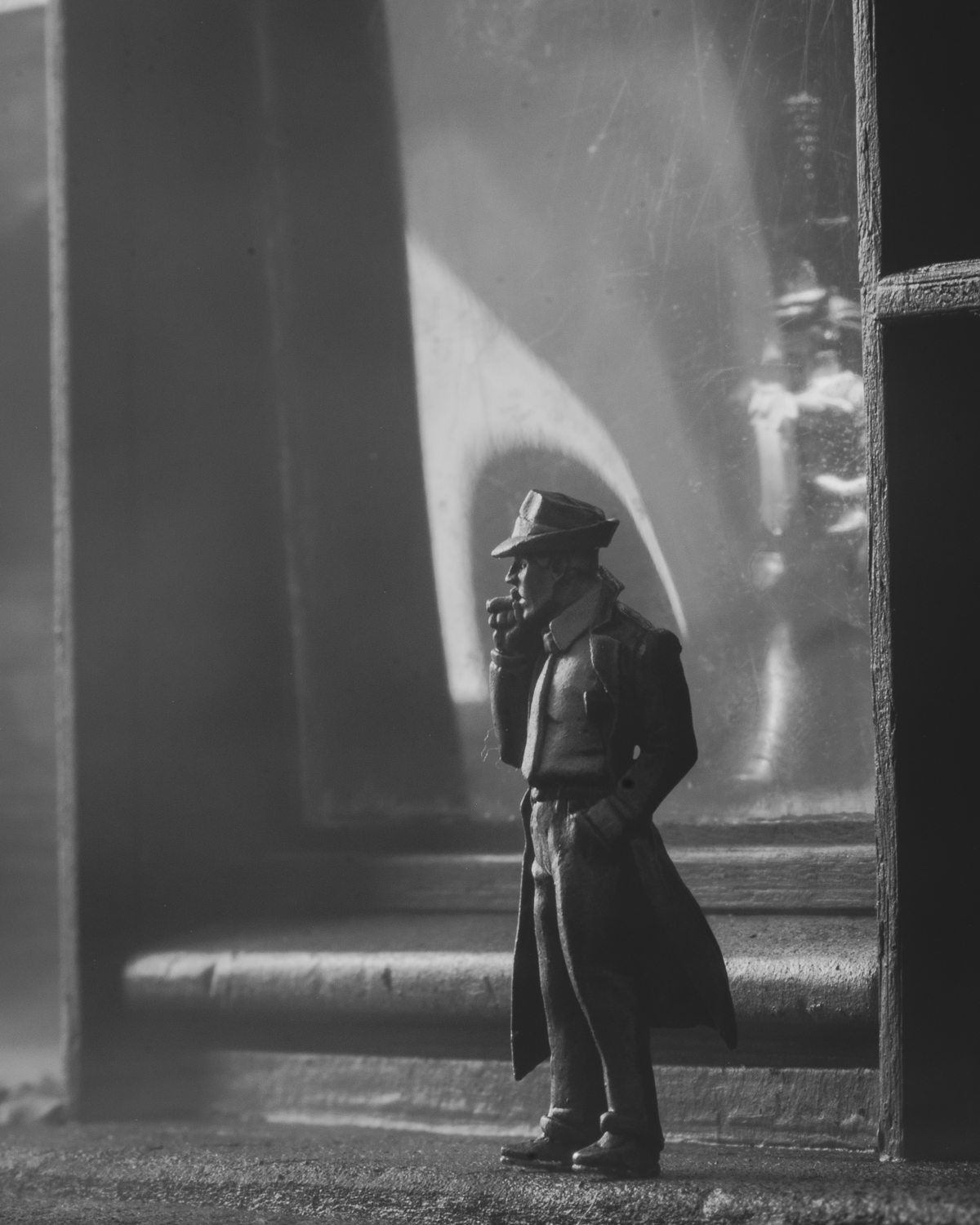
    The final photograph, Are They Watching Me?, is ultimately an attempt to explore how unease can emerge from stillness.
    What interests me is not whether the scene appears perfectly real, but whether it feels psychologically convincing. The miniature world remains visibly artificial, yet perhaps that artificiality allows the image to operate more like memory or cinema than straightforward documentation.
    In that sense, Feininger’s observation becomes even more meaningful: technical imperfection is not necessarily a limitation. Sometimes it is precisely what allows an image to become emotionally alive.

    Are they watching me?
    Are they watching me?

    Rather than translating Feininger’s social tension directly, I became interested in how miniature photography could transform it into psychological unease — a shift from class and visibility toward surveillance, perception, and self-awareness.

    Technical Details

    • Camera: Pentax K-5
    • Lens: HD PENTAX-D FA Macro 100mm F2.8ED AW
    • Settings: f/22 · ISO 400 · 3.0 s exposure
    • Post-processing was done using Adobe Lightroom, Adobe Photoshop, and Nik Silver Efex.

    Print

    • 19 × 16 cm
    • Printed on Hahnemühle Museum Etching paper, 350 g/m²
    • Wooden frame with museum glass and passe-partout
    Are they watching me? - 19x16cm print on Hahnemühle Museum Etching paper
    Are they watching me? – 19x16cm print on Hahnemühle Museum Etching paper
  • LDR inspired by DTNR

    LDR inspired by DTNR

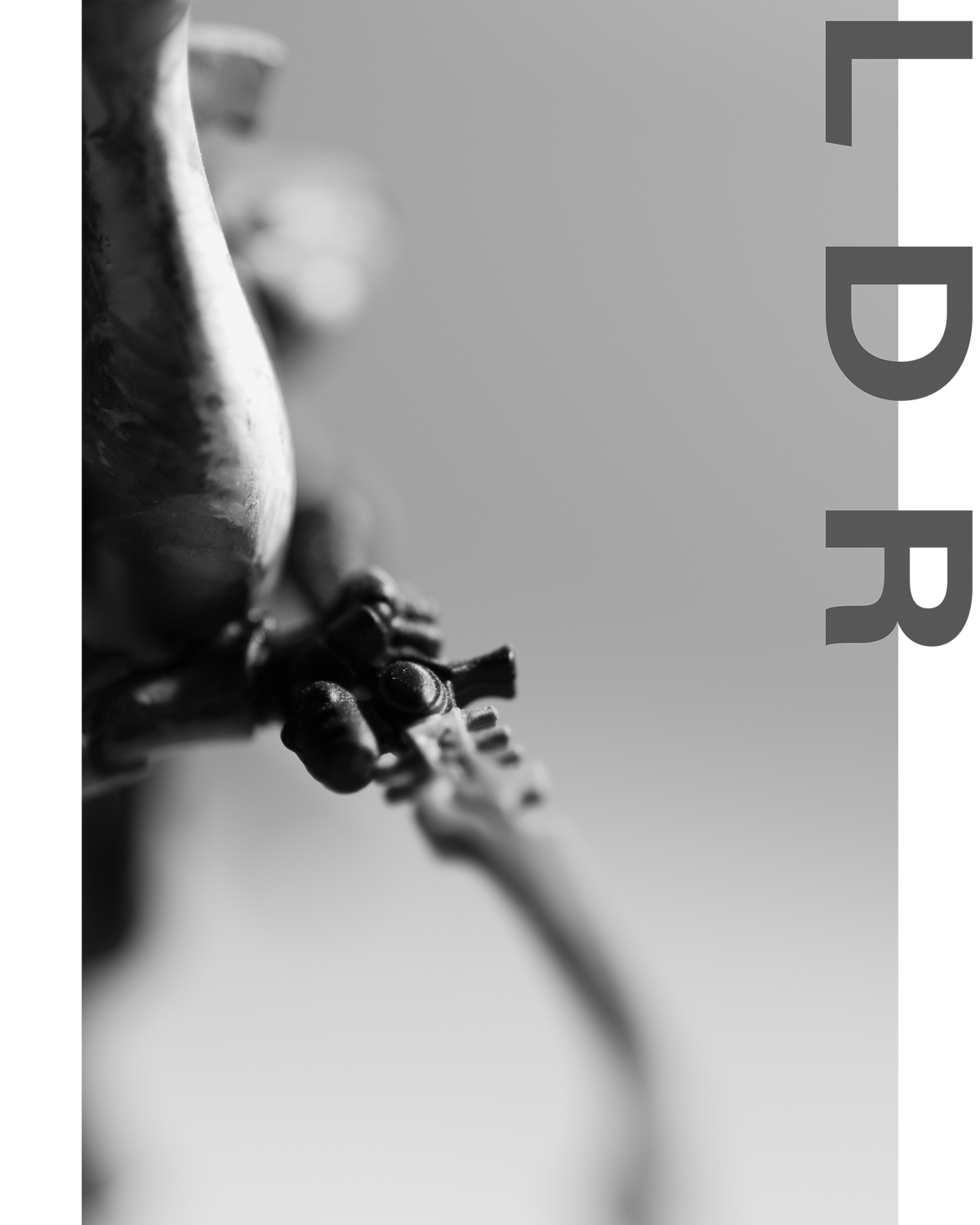
    Fascinated and inspired by Daniel Hahn’s Daytoner/ DTNR concepts (https://daytoner.net) I wanted to test if I can achieve similar styles in miniature photography. To make it simple I’ve taken my kitbashed Eldar models (hence LDR as an homage to DTNR). They already have something alien and robotic to them so that I was able to focus on light, shadows and atmosphere.

  • Silver in Fine Art Photography

    Silver in Fine Art Photography

    I’m happy to announce that my photograph You never came back is a winning entry in the Muse Photography Awards 2026 and was awarded Silver in the Fine Art Photography – Forced Perspective category.

    You Never Came Back
    You Never Came Back

    Check out my post how I made this photograph on You Never Came Back. Here’s the link to the winner info.

    Silver in Fine Art Photography - Forced Perspective in the Muse Photography Awards 2026
    Silver in Fine Art Photography – Forced Perspective in the Muse Photography Awards 2026

    Congratulations to all winning participants.

  • Testing Forced Perspective

    Testing Forced Perspective

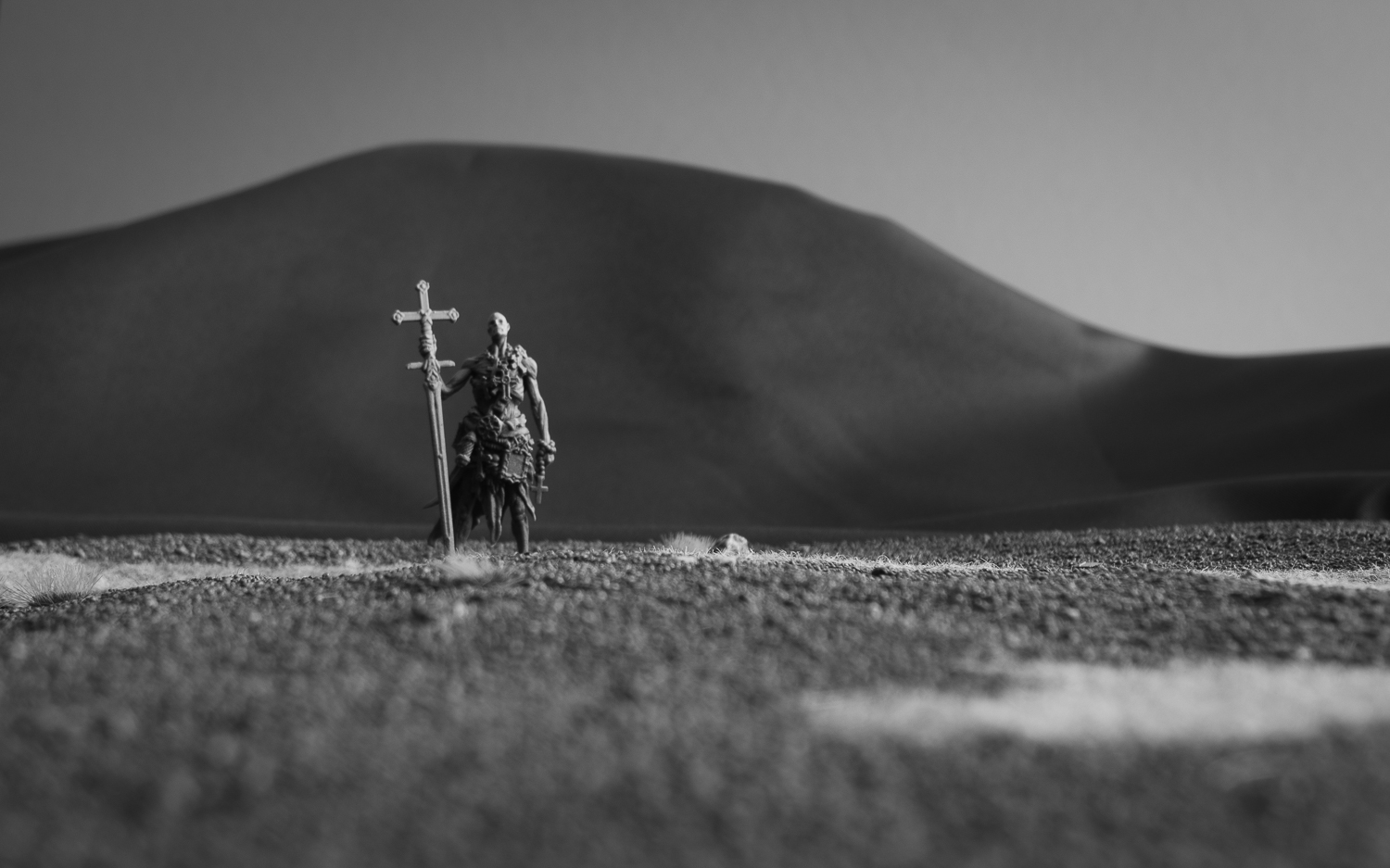
    Due to the scale it’s hard to make photographs with miniatures in 28mm standing “in the open”. This approach is pretty easy and imitates a hill or mountain range far away from the miniature.

    Forced Perspective Miniature Photography with a miniature in 28mm scale and a mountain range in the background.

    For a cloudless sky I’ve placed a red paperboard in the back. Between the miniature and the paperboard I’ve placed a green cloth carefully shaped as a mountain or hill range. It’s important that there’s no wrinkles revealing that it’s only a cloth. Have a look at real mountain or hill ranges. Try to make the shapes as smooth as possible. Play with the shadows on the cloth.

    The 15mm lens helps with the illusion as does the aperture of f/5.6, blurring the background only slightly.

    You can check out my Truffles & Dermaphytes post where I’ve applied the same technique.

    Studio setup for the forced perspective photograph.
  • You Never Came Back

    You Never Came Back

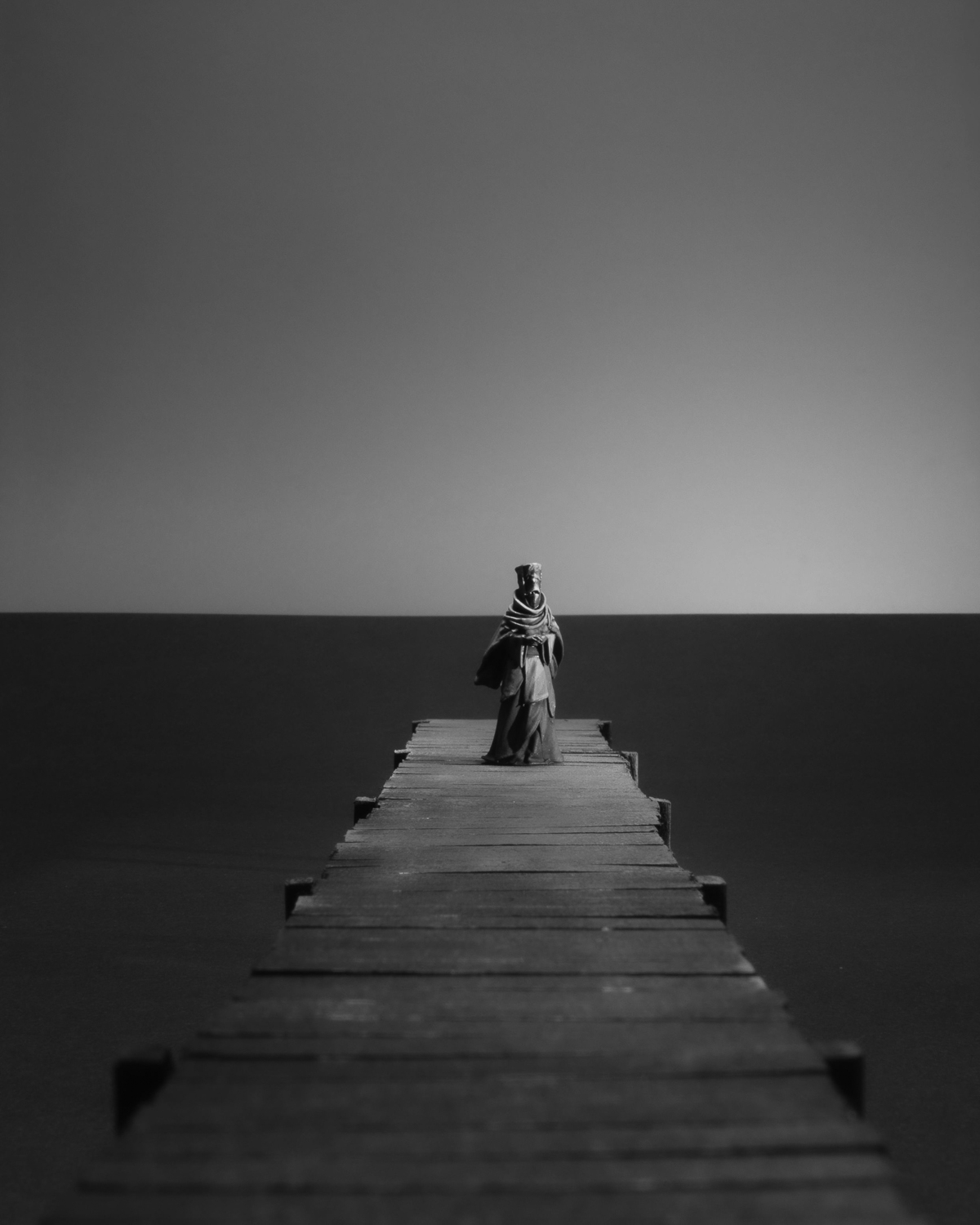
    What if you go to the place of departure every day waiting for them to come home?

    You Never Came Back
    You Never Came Back

    Scene created with a hand painted 3D printed miniature in 28mm scale on a hand crafted pier using cardboard as water and sky.
    The miniature scale intensifies the unease: a small world frozen at the exact moment before realization sets in. Paint and texture mimic decay, suggesting salt, rot, and long exposure to grief. Nothing moves, yet everything implies what once did. The scene captures the cruelty of hope when it outlives reason—a quiet, sinister stillness where the act of waiting becomes the final connection to those who will never walk back along the pier.

    Forced Perspective

    The issue with taking photographs of miniatures in miniature terrain is that the terrain won’t stretch to the horizon. It will always stop when the terrain ends which is usually below the eye level horizon when you take the photograph horizontally. A way to hide this is to hide the true horizon behind scenery of any sort. Which can ruin the illusion. In the 28mm scale a terrain piece of 120cm depth would translate to roughly 60m. When you are taking photographs of people outside (as in Long Shots, Wide Shots or Establishing Shots), try to find a spot where your view is blocked everywhere within 60m.

    As I wanted to create a scene by the sea I needed a horizon on roughly the miniature’s eye level to create the illusion. It was beneficial that I didn’t plan to have much water texture/ movement in the photograph because I wanted to maximize the negative space around the object.

    In the end I’ve worked with two paper sheets. A black one which lay flat on the table and which I slightly bent at the far side so that it simulated the horizon. And a grey paper sheet to simulate a cloudless sky.

    With the help of three lights everything was set up for the photograph.

    Simple studio setup

    Miniature Design by Rescale Miniatures – painted by me.

  • The Tunnel

    The Tunnel

    Read how I’ve created The Tunnel – fine art miniature photography inspired by Jeff Bridges. It’s Peter McKinnon’s fault.

    But first I’d like to dedicate this piece of work to Per’s brave son Henry who is fighting a brain tumor. Please read the whole story on https://www.crafting-for-hope.com and support Per’s donation fundraiser for treatments invented at St. Jude Research Hospital, Memphis, Tennessee, via https://fundraising.stjude.org/site/TR/DIY/DIY?px=8473521&pg=personal&fr_id=133399

    For further support you might want to use #craftingforhope whenever you share the campaign.

    the inspiration

    While I was recovering from a surgery I was watching YouTube videos. What happens when you‘ve been watching for too long is that you start scrolling through the feed without finding any new videos of interest. So I’ve watched this Peter McKinnon video. Not that I watch his videos regularly but YT does suggest them as I‘m generally interested in photography content. Anyhow it happened to be about the Wideluxx camera which provides you with a really interesting perspective due to its super wide angle.

    And then he showed a couple of pages of one of Jeff Bridges‘ photo books. When he flipped a specific page and once my brain processed what it saw I was immediately super excited. It was so inspiring that I stopped the video and started searching for the photo on the web.

    But it seems that exactly this photo is not to be found. So I searched for the book which is out of press. And I found it. For a price I couldn‘t afford. But I wanted to make a photograph with miniatures inspired by this very photograph made by Jeff Bridges.

    In the end my only reference was a screenshot from Peter‘s video. I don‘t know from which film the photograph is and I don‘t know in what kind of construction the scene takes place. Maybe inside a tunnel, a plane maybe?

    Jeff Bridges' Widely photograph, screenshot from a Peter McKinnon video
    screenshot from Peter McKinnon’s video showing Jeff Bridges’ photograph

    the process

    This screenshot, my reference for my work, was the starting point for my analysis. What story was told, why was it so intriguing to me? How did light and shadow play along? How was the camera placed? What details in this very dark photographs were visible? What was the composition? And why – again – was it so appealing to me?

    materials used

    What I needed was this tunnel, a set of miniatures and proper lighting. Lighting and miniatures were already at hand. Lighting because it‘s part of my setup. Miniatures because I had a set of kitbashed and painted miniatures with which I wanted to create something anyhow.

    Leaving me with the tunnel which I had to craft. The original photograph by Jeff Bridges does not have any light sources within the tunnel. But for my interpretation I wanted them. That‘s why I‘ve added an LED strip to the tunnel ceiling.

    The miniatures I wanted to be part of my work are 3D printed miniatures designed by Reconquer Designs and plastic miniature designed by Games Workshop. All of them I‘ve modified and kitbashed so that they fit into my Knights of Embersworn setting. To be able to place the miniatures properly I‘ve replaced their bases with needle tips so that I can easily push them into the floor made out of xps foam.

    The tunnel I’ve crafted out of cardboard, xps foam and an LED strip. With cardboard I’ve created the walls and the ceiling and their details. The floor and the beams to hold the structure are made out of xps foam. The windows are just a plain white 80g/m2 printer paper. The paint job is straight forward using cheap black, brown and terracotta acrylic paint from the hardware store which I put on with a sponge.

    a quick test shot

    In order to be able to place the miniatures easily the ceiling and the walls are not glued together. And yet I had to make sure that there‘s no gap letting through any light from the side.

    the photo setup

    The original photograph by Jeff Bridges has two light sources. On the left side there‘s light coming in through windows. From the rear of the tunnel-like construction. I‘ve made test setups with whatever I had at hand but it quickly became clear that I wanted to add the ceiling lights.

    miniatures in a test setup for the tunnel
    miniatures in a test setup for the tunnel

    The paper window needed a strong light source from the left. Here I‘ve set up my amaran 200x from aputure. The rear light didn‘t need to be that strong. My LUMIS LED Panel 600 RGB from Rollei was sufficient. Still I had to diffuse its light with another plain white paper. I didn‘0t want the rear light to as strong as in the original.

    After a couple of test photos it was clear that I wanted to emphasize the foreground a bit more for which I placed an additional spot.

    As I don‘t have a Widelux camera and I doubt that it is useful for miniature photography I used my laowa 18mm probe lense.

    The most challenging part was to trigger the camera shutter at the right time when the fog was distributed in the most fitting way.

    post processing

    In Adobe Lightroom I changed to a 16:9 ratio. The Widelux of course must have a ration 2:1 or 3:1. But I did not necessarily try to replicate the Widelux style but create an interpretation of the original with what I have.

    Also I‘ve adjusted the lighting slightly with a couple of masks.

    The result I‘ve processed in Nik Silver Efex for a proper Ilford hp5 plus 400 analogue film style.

    In Adobe I‘ve added some subtle haze to the scene.

    the result

    Knights of Embersworn in a tunnel - black and white miniature photography
    The Tunnel

    Printed on Hahnemühle Museum Etching fine art paper. This is the best way to enjoy such pieces or art.

    the story in the photo

    When she entered the tunnel with her retinue she already knew that the recon team had been overwhelmed. How badly was to be found out. The fog was dampening down the food steps on the cold floor. Slowly the went inside. A moan. A slowly raised hand, reaching for help.

    This work is set in a dystopian world with the Knights of Embersworn being just one of many factions. If you want to see more related works please read my other posts for Truffles&Dermaphytes.